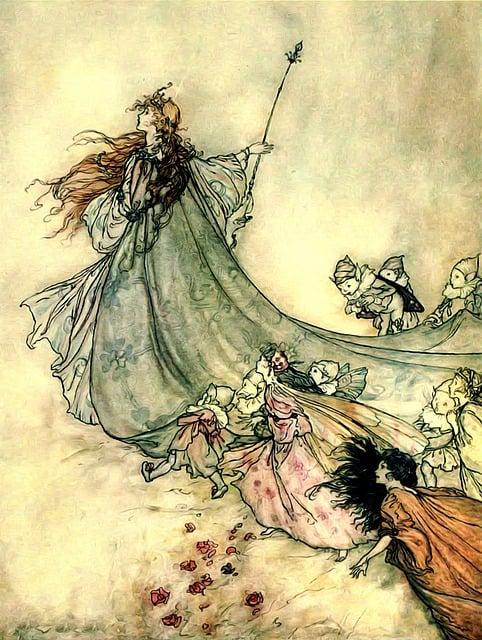
Stepping into the whimsical realm of Shakespeare’s “A Midsummer Night’s Dream,” Act 3, Scene 1 unfolds with mischief and mishaps.
1. Unveiling the Magical Realm: An Overview of Act 3, Scene 1 in A Midsummer Night’s Dream
Act 3, Scene 1 in William Shakespeare’s beloved play, A Midsummer Night’s Dream, takes us on a mesmerizing journey into the enchanting realm of magic. This pivotal scene introduces us to an array of fascinating characters and sets the stage for the whimsical chaos that ensues.
One of the central highlights of this scene is the fierce lover’s quarrel between the fairy king and queen, Oberon and Titania. Their passionate, yet tempestuous relationship provides a captivating backdrop to the unfolding events. As their bickering intensifies, we witness the tenuous balance of power within the fairy kingdom, where love and jealousy intertwine to create a world of uncertainty.
Furthermore, Act 3, Scene 1 introduces us to the infamous mischievous character, Puck. This sprightly and impish fairy, whose misadventures often lead to hilarious consequences, becomes a pivotal player in the ensuing confusion. Puck’s meddling with a love potion sets off a chain of events that entangles the lives of the four Athenian lovers and plunges them into a whimsical realm of mistaken identities and twisted emotions.
Prepare to be transported to a parallel universe full of magic, chaos, and unrequited desires as Act 3, Scene 1 unravels the complexities of Shakespeare’s A Midsummer Night’s Dream. Brace yourself for an unforgettable journey through the intricate web of love, illusion, and transformation that defines this timeless masterpiece.

2. Lovers Bewitched: Delving into the Confusion and Folly
Act 3, Scene 1 of Shakespeare’s enchanting comedy, A Midsummer Night’s Dream, takes us deeper into the entangled web of love and confusion. As the night grows darker and mischief lurks, our beloved characters find themselves bewitched and trapped in a realm of absurdity.
In this scene, we witness the love-struck quartet, Hermia, Lysander, Helena, and Demetrius, lost in the mystical forest. Their emotions swirl like a tempest, driven by the mischievous Puck and his enchanting love potion. As the confusion mounts, our lovers’ senses become twisted, and what once seemed real now appears as mere folly.
Amidst the chaos, we delve into the depths of the human heart, exploring themes of desire, obsession, and the fickleness of love. Shakespeare skillfully portrays the fragile nature of human relationships and the irrationality that can plague even the most sensible minds.
- Helena’s unrequited love for Demetrius reaches new heights, as she is tormented by his rejection and his newfound affection for Hermia.
- Lysander’s sudden change of heart leaves Hermia devastated, as his love for Helena grows stronger due to Puck’s meddling.
- As Hermia confronts her betrayal, her fury and confusion blend into a potent cocktail of emotional turmoil.
The stage is set for a comedic and confusing encounter, where misplaced love and bewitchment intertwine, ultimately pushing our characters toward a climactic resolution in this delightful comedic masterpiece.

3. Puck’s Mischief Unleashed: The Transformative Power of Love Potions
As Act 3, Scene 1 of Shakespeare’s enchanting masterpiece, “A Midsummer Night’s Dream,” unfolds, we find ourselves submerged in a world where mischief and love intertwine in the most unexpected ways. In this pivotal scene, the mischievous sprite Puck wreaks havoc by administering a love potion, igniting a web of unanticipated romantic entanglements among the unsuspecting characters.
With a sprinkle here and a drop there, Puck weaves his enchanting spell, and suddenly, the audience is transported to a realm where love is not bound by reason. As the characters awaken from their slumber, their feelings become muddled and their desires distorted. This transformation, brought about by the power of the love potion, exposes the fragility and unpredictability of human emotions.
This pivotal scene showcases the transformative power of both love and mischief. It emphasizes the universal truth that love has the ability to transfigure the human soul in remarkable ways. The characters are not just consumed by infatuation and desire; they are stripped of their inhibitions and find themselves chasing what their hearts truly long for, oblivious to their previous intentions.
Key Takeaways:
- Puck’s mischievous love potion is at the center of Act 3, Scene 1, unleashing unexpected romantic chaos.
- The love potion demonstrates the transformative nature of love and the unpredictable power it holds.
- The characters’ desires become distorted, highlighting the fragile and complex nature of human emotions.

4. The Disruption of Social Order: A Closer Look at the Mechanicals’ Play
In Act 3, Scene 1 of A Midsummer Night’s Dream, the audience is introduced to the hilarious incompetence of the mechanicals as they attempt to put on their ill-fated play, “The Most Lamentable Comedy and Most Cruel Death of Pyramus and Thisbe.” This comical interlude serves as a striking disruption to the social order within the play, highlighting the stark contrast between the refined world of the nobility and the crude performances of the working class.
The mechanicals, comprised of amateur craftsmen, stumble through their lines, revealing their lack of theatrical skills and knowledge. This deliberate portrayal of incompetence adds a layer of irony, as the mechanicals’ play is meant to entertain and celebrate Theseus’s upcoming marriage. However, their performance appears to mock the aristocratic tradition of drama, turning the tables on the established social hierarchy.
Shakespeare’s inclusion of this play within the play offers a critical commentary on the power dynamics between different social classes. By juxtaposing the fluidity and grace of the noble characters with the clumsiness of the mechanicals, he not only brings humor to the scene but also questions the notion of social order and challenges the idea that the aristocracy holds a monopoly on culture and refinement.

5. Analyzing the Symbolic Interactions: Love, Jealousy, and Deception
In Act 3, Scene 1 of Shakespeare’s masterpiece “A Midsummer Night’s Dream”, we are transported into the enchanted forest where love, jealousy, and deception intertwine in a whimsical dance. This scene showcases the intricate web of relationships and emotions that govern the lives of the characters, taking us deeper into the heart of the play’s themes.
Love takes center stage as we witness the tangled affairs of the quartet: Hermia, Lysander, Demetrius, and Helena. Amidst the dark woods, infatuation turns to desperation, as love potions and mischievous fairies blur the lines between reality and fantasy. Through their interactions, we see the power of love to ignite passion, incite jealousy, and even inspire deception.
Jealousy, a bitter companion of love, lurks in the shadows throughout this scene. Helena’s unrequited love for Demetrius fuels her jealousy, leading her to reveal Hermia and Lysander’s secret plan to escape together. Meanwhile, Oberon’s jealousy over Titania’s affection for a weaver-turned-ass sets in motion a series of events that will test the boundaries of trust and loyalty.
Deception, an ever-present theme in Shakespeare’s plays, takes on a magical twist in this scene. Puck, Oberon’s mischievous servant, gleefully meddles with the lovers’ fates, transforming their affections at will. As the characters navigate a landscape of illusion and false identities, we are reminded of the delicate balance between truth and deceit, and how easily the line between the two can be blurred.
Act 3, Scene 1 of “A Midsummer Night’s Dream” is a captivating exploration of the complexities of human relationships and the transformative powers of love, jealousy, and deception. As the characters grapple with their emotions and navigate the enchanting forest, we are transported into a world where reality and illusion merge, leaving us enchanted and eager to discover what lies ahead in this magical tale.
6. Transforming Chaos into Comedy: Shakespeare’s Ingenious Use of Misunderstandings
In Act 3, Scene 1 of “A Midsummer Night’s Dream,” Shakespeare masterfully demonstrates his knack for transforming chaotic situations into uproarious comedy through the clever use of misunderstandings. This scene takes place in the enchanted forest, where the love-struck characters are entangled in a web of confusion and mistaken identity.
One of the key moments in this scene is when the mischievous Puck, under the influence of a love potion, mistakenly anoints the eyes of the wrong Athenian man. Instead of falling in love with Hermia, as intended, Lysander awakens to find himself infatuated with Helena, a complete reversal of his previous affections. This misunderstanding sets off a chain reaction of hilarious events, as both Demetrius and Hermia are now left bewildered and desperate to win back their lost loves.
Furthermore, the introduction of the rude mechanicals in this scene adds another layer of comedic chaos. These working-class actors, blissfully oblivious to their lack of talent, decide to rehearse their play in the same enchanted forest. Their misguided attempts at performance, coupled with their comedic misinterpretation of Shakespearean language, create a perfect blend of slapstick humor and wit.
Through these ingenious misunderstandings, Shakespeare transforms chaos into comedy. His ability to navigate the tangled web of love, deception, and miscommunication allows for an entertaining exploration of human follies and the complexities of romantic relationships. This scene serves as a quintessential example of Shakespeare’s comedic genius, leaving audiences amused and charmed by the power of misunderstandings on the stage.
7. Unlocking the Depths: Revealing the Characters’ True Desires and Motivations
In Act 3, Scene 1 of Shakespeare’s “A Midsummer Night’s Dream,” the undercurrents of the storyline surge to the surface, revealing the characters’ true desires and motivations. This pivotal scene takes place in the enchanted forest, as the realm of the faeries collides with the human world, setting off a sequence of events that will forever alter the course of the play.
<p>
    As the night unfolds, the mischievous Puck, fueled by Oberon's meddling, decides to play a game of love and confusion. Armed with a magical flower, he sets out to manipulate the affections of the unsuspecting humans. However, this mischievous act unravels something much deeper within the characters, exposing their hidden longings and pent-up frustrations.
</p>
<p>
    While Puck's antics initially seem like mere entertainment, they serve as a catalyst for self-discovery as the characters find themselves caught in a web of their own desires. **Hermia**, strong-willed and defiant, confronts her love for **Lysander** and challenges societal expectations. **Helena**, plagued by unrequited love, unravels her desperation and confronts her own self-worth. Meanwhile, **Demetrius** and **Lysander's** sudden infatuation with Helena raises questions about the <a href="https://worldofspiritualism.com/nofap/masturbation/the-surprising-connection-between-masturbation-and-sadness/" title="The Surprising Connection Between Masturbation and Sadness">true nature</a> of love, loyalty, and the fickleness of the human heart.
</p>
8. A Night of Revelations: Implications and Lessons Learned in Act 3, Scene 1
Welcome to our exploration of Act 3, Scene 1 of Shakespeare’s enchanting play, “A Midsummer Night’s Dream.” In this memorable scene, aptly titled “A Night of Revelations,” revelations and consequential lessons unfold, setting the stage for a whirlwind of events and character transformations. Join us as we delve deeper into the implications and lessons learned in this pivotal moment of the play.
The Mirror of Love: Act 3, Scene 1 opens the door to a web of tangled love affairs. The meeting between the ill-fated lovers Hermia, Lysander, Demetrius, and Helena takes place in the bewitched forest, where the chaotic energy of Oberon’s meddling magic reigns supreme. As the lovers find themselves lost in this mystical realm, the truth of their hearts is laid bare, exposing their emotional vulnerabilities, confused desires, and deep-seated insecurities. Their undeniable revelations force them to confront the complexities of their feelings and their own misguided actions, ultimately leading to profound transformation.
The Unmasking of Bottom: Act 3, Scene 1 also imparts a powerful lesson in self-discovery. We witness the hilarious and surreal moment when the weaver and amateur actor Bottom, who has been enchanted with the head of a donkey, becomes a spectacle for the fairy queen Titania’s eyes. This unanticipated revelation forces Titania to step out of her regal facade and confront her own romantic delusions. Through the allegorical presence of Bottom, Shakespeare reveals the folly of appearances and the importance of seeing beyond the superficial, urging us to examine both the masks we wear and the masks we place upon others.
In Act 3, Scene 1 of “A Midsummer Night’s Dream,” Shakespeare masterfully weaves together themes of love, illusion, and transformation. Through the revelations and lessons learned by the characters, we are invited to reflect upon our own desires, vulnerabilities, and ability to embrace the stark realities of our lives. As we journey through the enchanted forest, let us extract the valuable insights provided by these intricate revelations and allow them to enlighten our own journey of self-discovery and understanding.
In Act 3, Scene 1 of “A Midsummer Night’s Dream”, Shakespeare weaves a tapestry of love and chaos. Key takeaways: mistaken identities, magical mischief, and the power of love’s spell. Dive into this enchanting scene and unravel the secrets of the night.
Get our latest guides, news, and insights highlighted in your Google Search & AI Overviews.


